


Bitcoin runs a transparent system designed to verify and control the supply of new coins. The two important processes behind this system are mining and halving. Bitcoin mining creates new blocks on the blockchain, while Bitcoin halving reduces miners’ rewards to slow the release of new Bitcoin into circulation.
In this guide, let’s take a deep dive into both of these concepts and why they are important.
Key Takeaways

- Mining validates transactions and secures Bitcoin. Miners compete to add new blocks to the blockchain and earn rewards, helping keep the system safe and decentralized.
- Every four years, Bitcoin’s rewards are cut in half to limit new coin issuance and maintain Bitcoin scarcity.
- Historical halving events show significant price increases due to higher demand and lower supply.
- After all bitcoins start circulating, miners will earn solely from transaction fees, ensuring the network continues without new Bitcoin creation.
What is Bitcoin Mining
Bitcoin, a digital currency, uses mining to secure its network and validate transactions. It does it through a process called mining. Basically, a network-wide competition takes place between miners to find the solution to a complex computational puzzle. The first miner to win gets rewards in the form of Bitcoin and the fees of the transaction.

Bitcoin mining will continue as long as all 21 million bitcoins come into circulation. After that, it is expected to stop. Miners will get rewards for validating transactions, while Bitcoin will be available to buy on cryptocurrency exchanges.
How Bitcoin Mining Works
This is how Bitcoin mining happens.
Transactions Are Collected

When people send Bitcoin, these transactions do not go directly to the blockchain. Instead, they first go to a waiting area called mempool. Miners pick a group of these transactions and bundle them into a block.
A Block Gets a Digital Fingerprint (Hash)
Each block is then run through a cryptographic algorithm called SHA-256. This algorithm turns all the block’s data into a 64-character string, known as a hash.
Even a small change in the data can completely change the hash. It is also one-way, meaning you cannot reverse it to see the original data. Moreover, each block contains the previous block’s hash. This links all blocks together, hence creating the blockchain.
Miners Compete to Solve a Cryptographic Puzzle
Here is the real mining part. The Bitcoin network sets a target value. Miners have to generate a hash that is equal to or lower than the target. So, what miners do is, they

- Add a number called nonce
- Run the block data and nonce through SHA-256
- Check the resulting hash
- If it does not meet the target, they try again with a new nonce
Miners repeat this process billions or trillions of times per second. This trial-and-error process is known as Proof-of-Work (PoW).
First Miner to Find Valid Hash Wins
When a miner generates a valid hash, they broadcast it to the whole network. Other nodes verify it, and if it is valid, the block is added to the blockchain.
The winner receives a block reward, which is currently 3.125 BTC after the 2024 halving, plus transaction fees from that block.
Blocks Are Confirmed

After a block is added, new blocks are built on top of it. Each new block adds another confirmation. After around 6 confirmations, the transaction is considered very secure.
Mining Difficulty Adjusts Automatically
The Bitcoin network adjusts difficulty every 2,016 blocks (around 2 weeks). If mining is happening fast, the difficulty automatically increases. If the mining is slow, the difficulty decreases. This keeps block time around 10 minutes on average.
Economics of Bitcoin Mining
The following are the three main costs involved in Bitcoin mining.
Electricity
Mining creates a substantial electricity bill because this is the power you need to run mining systems 24/7. The network-wide mining process can consume as much electricity as certain countries.
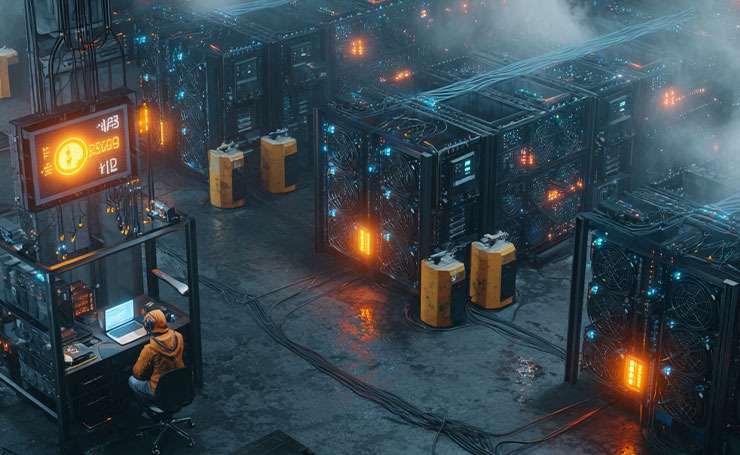
Moreover, you also need to cool the area where you keep your mining systems, as they produce a lot of heat. Using air conditioning also increases electricity bills.
Mining Systems
Despite the contrary belief, you can use desktops or gaming computers for mining by joining a mining pool. However, these regular systems cannot compete with ASIC mining machines. You also need to buy several ASIC miners and join the pool. The machine that works faster is more expensive.
Network Infrastructure
Mining does not require fast internet speeds, but it gets impacted due to latency. Latency means the amount of time it takes to communicate with the rest of the network. Low communication delay is essential so that results reach the network quickly and aren’t rejected.

Large mining farms need multiple internal connections to connect each mining rig to a server or a router with internet access.
However, if you are using your gaming rig to join the pool and mine, you do not need any extra bandwidth, just a stable, low-latency connection to the mining pool server.
Common Bitcoin Mining Scams
Bitcoin and its mining attract a lot of scams. If you want to start mining, you need to stay vigilant before investing in any tools, networks, or software.
Cloud Mining Platforms

These websites claim to rent mining power to customers. While not all of them are scams, you should read reviews, talk to others, and do your homework completely before selecting one.
Fake Wallets
Cryptocurrency wallets store your private keys. However, scammers create fake wallets to steal them. Therefore, always use a reputable and trustworthy Bitcoin wallet provider.
Fake Exchanges
There are many accounts of people who were contacted by these fake exchanges to pressure them into depositing funds, so stay vigilant if you receive such emails.
To avoid getting scammed, do not give your seed phrases, private keys, or passwords to anyone. Also, do not trust a person whom you have never met or a service that does not have an established reputation.
Now that we have understood what Bitcoin mining is, let’s move to Bitcoin halving and how it impacts Bitcoin prices and supply.
What is Bitcoin Halving?
Bitcoin halving is a process through which the Bitcoin reward is reduced by 50%. It happens every four years. It is important to lower the supply of Bitcoin in the market and increase scarcity.
Bitcoin rewards, as we discussed above, are a part of the blockchain’s process of validating transactions and adding new blocks (mining).
History table
| Halving | Year | Reward Before | Reward After |
| 1st | 2012 | 50 BTC | 25 BTC |
| 2nd | 2016 | 25 BTC | 12.5 BTC |
| 3rd | 2020 | 12.5 BTC | 6.25 BTC |
| 4th | 2024 | 6.25 BTC | 3.125 BTC |
How it Works
Rewards are given when new blocks create a chain containing information, known as the blockchain. With each halving event, miners’ rewards are cut in half to slow the pace at which new bitcoins are introduced into circulation.
In 2009, the reward was 50 BTC, but after the first halving in 2012, it became 25 BTC. Then in 2016, it was reduced to 12.5 BTC. The third halving set it at 6.25 BTC, and the fourth, most recent halving, set it at 3.125 BTC.
This process was designed by Satoshi Nakamoto, the creator(s) of Bitcoin, and it cannot be changed.
Bitcoin’s total supply is capped at 21 million coins. By March 2024, over 19 million had already been created through mining. That leaves roughly 2 million coins still to be produced. These remaining bitcoins will be released slowly through future mining rewards and halving.
Why is it Important?
As fewer bitcoins are issued over time, the halving makes their value rise. It is a sharp contrast to fiat currencies, which decline over time due to inflation. Halving is a way to maintain Bitcoin’s scarcity, which is why it is sought after by millions of people.

Halving is also important because it attracts more press coverage of Bitcoin and cryptocurrencies. More coverage piques the interest of potential investors. This surge leads to increased Bitcoin demand, as new and existing investors aim to capitalize on the potential price movements caused by halving.
The Relationship Between Bitcoin Halving and Bitcoin Price
There is a positive connection between Bitcoin price and halving. It is also worth mentioning that price is not only affected by halvings but also depends on other factors as well.
- First Halving: In 2012, the Bitcoin price was $11 and rose to $12. In a year, it became $1100.
- Second Halving: In 2016, the Bitcoin network completed 420,000 blocks, and the second halving happened. The BTC price fluctuated between $500 to $1000 for a few months and became $20,000 in December 2017.
- Third Halving: When the halving happened in May 2020, Bitcoin was trading around $9000. In December 2020, the price became $20,000.
- Fourth Halving: It is the most recent one that took place in April 2024. The Bitcoin price after halving closed at $63,851. After a year, in April 2025, the price reached $83,671. Within this current halving cycle, Bitcoin reached a record high of $126,210.50 on October 6, 2025.
What Happens after Halving?
The last halving is predicted to happen in 2140. The rewards will cease to be in the form of Bitcoin. Afterward, miners will be rewarded with fees from network users (individuals who buy and sell Bitcoin). Miners will also get incentives to continue processing transactions on the Bitcoin blockchain.
In a Nutshell
Bitcoin mining and halving both play an important role in the crypto world. Mining ensures that new transactions are validated and recorded on the blockchain, thereby earning miners rewards. Bitcoin halvings ensure Bitcoin scarcity by slashing these rewards in half and limiting its supply.
For more up-to-date information on Bitcoin, feel free to explore The Crypto Trends.
FAQs
How does Bitcoin Mining affect Electricity Consumption Worldwide?
Bitcoin mining utilizes an enormous amount of electricity because ASIC mining rigs operate continuously. Countries with cheaper energy often have large mining farms, which influence local power grids and energy policies.
Can Small Investors Profit from Joining Bitcoin Mining Pools?
Yes, small investors can join mining pools to share computational power and get fractional rewards without owning expensive mining hardware. It makes mining accessible at a lower cost.
How does Bitcoin Halving influence Long-term Market Volatility?
Bitcoin halving reduces the block reward, which lowers the new Bitcoin supply. This scarcity often triggers price spikes, higher market volatility, and increased trading activity over the following months.
How do Mining Difficulty Adjustments maintain Bitcoin Network Stability?
Bitcoin automatically adjusts its mining difficulty every 2,016 blocks to ensure a 10-minute average block time. It keeps the system stable despite fluctuating computational power.
