


20-Second Summary
Decentralized Finance (DeFi) has introduced a new way for people to manage their money online, with a decentralized way of conducting financial transactions without having to go through centralized intermediaries.
With the help of DeFi, users can access financial services like lending, borrowing, trading, and investment opportunities through the decentralized applications (dApps), with an internet connection.
The DeFi systems leverage blockchain technology along with smart contracts for enabling secure online financial transactions, but we cannot state it to be completely risk-free despite its remarkable benefits.
Investors should understand each concept of Decentralized Finance before participating in its activities.
This guide will explain DeFi in detail, along with its benefits, risks, and challenges, so that you completely understand it before making any decisions on adopting it for your financial transactions.
What is Decentralized Finance and Why It Matters
Decentralized Finance, commonly abbreviated as DeFi, is all about the operation of financial services like lending, borrowing, and trading investments securely, using the internet and without any centralized intermediaries.

All the financial functions get executed with the help of coding automatically without any centralized institutional decision-making.
- With the help of DeFi, around 1.7 billion people on the earth, who do not own any bank accounts, have the possibility of participating in the global economy by conducting financial transactions using their mobiles and internet connection.
- Other than this, people living in countries with unstable currency or unreliable financial institutions can also leverage Defi as a liberation from their financial exclusions.
Defi is not merely a technological innovation, but instead it enables you to maintain your financial assets in a decentralized system using the financial services that do not tie you to a specific institution and its regulations for any transactions.
DeFi Explained in Simple Terms
To explain in simple terms, Defi is a financial system where your financial transactions are executed automatically by computers using coding. Unlike a traditional banking system that operates with a central authority, Defi operates via distributed networks without any central organization or authority controlling any transaction.
In DeFi, your digital assets remain in your control through digital wallets. You can further understand this with the following simple examples:
- Let’s assume that you need to borrow some money. Now, with a traditional bank, you will have to sit with a loan officer to start the process, but with a Defi system, you can borrow funds by interacting with the lending system directly using codes.
- Similarly, for trading, you exchange assets directly with other users through transparent protocols, totally avoiding going through a broker.
The Shift from Centralized to Decentralized Systems
Human kind has been relying solely on the centralized finance systems, where the traditional financial institutions acted as the middle authority for record keeping, transactional validations, and entrusting trust.

Man was restricted from using the centralized institutions, where they had to be restricted to their regulations and pay a high fee for managing their financial transactions.
Many lacks were visible in the financial intermediaries, including the:
- Additional transactional costs
- Delay in the process of conducting any transaction
- The risk of hacking of the banking systems
- The authority of the government to freeze the accounts of users without notice
- Collapse of traditional currencies
Blockchain technology changed this equation. Distributed ledgers were created, where thousands of computers maintain identical records, eliminating the need for centralized intermediaries.
Every transaction done using the blockchain technology is:
- Recorded transparently
- Cryptographically secured
- Virtually impossible to change or manipulate
The decentralized nature of these systems means no single entity can manipulate the network, and anyone trying to engage in any fraudulent activity can be caught immediately.
This shift from centralization to decentralized structures represents one of the most significant financial innovations since the creation of banking itself. Instead of trusting institutions, participants trust mathematics and transparency.
How Blockchain Powers DeFi
Blockchain uses the distributed ledger technology. This is a transparent ledge that is visible over thousands of computers that can be maintained simultaneously. The information of each transaction is connected to the previous blocks of that chain, creating a permanent record that cannot be altered, hence making it an immutable historical record.
The complete blockchain system works on the consensus mechanism, where each transaction requires the consensus of thousands of computers for validating it, rather than depending on one central authority to validate the transaction.
This decentralized verification process eliminates the need for trusted intermediaries while preventing fraud.
How Smart Contracts Power DeFi
Smart contracts represent the second critical component powering DeFi.

Smart contracts can be thought of as the self-executing digital agreements running on a blockchain. The terms and conditions of the contracts are written in the form of code, and whenever a transaction is made, and the specific transactional conditions are met, the smart contract codes automatically carry out the financial actions without needing a bank or lawyer.
The smart contract code enforces the rules automatically, transparently, and irreversibly.
To understand the smart contracts in DeFi easily, let us take the example of the loan-taking requirements of a centralized bank system.
- In a traditional bank, loan officers are required to evaluate creditworthiness, approve applications, and manage payments, needing you to visit them frequently throughout the borrowing and repayment process.
- But if you use DeFi for lending using smart contracts, this entire process is automated.
- A borrower deposits cryptocurrency assets as collateral directly into the smart contract.
- The code automatically lends funds at predetermined rates.
- When payment times come, the code automatically withdraws repayments.
If the borrower defaults, the contract automatically seizes the collateral. No human intermediaries, no delays, no discretionary decisions.
How Decentralized Finance Works Behind the Scenes
In order to understand how Decentralized finance works behind the scenes, we need to know that it operates using the DeFi applications, which are sophisticated computer programs that run on a blockchain network.

Upon interacting with a DeFi application, a person sends the instructions to software systems that execute the transactions automatically, and below you will find how it works:
- First, your interaction must be authorized using your private cryptographic key. This key proves that you are the verified owner of your digital assets being used for the transaction.
- Upon verification, the cryptographic security ensures that only you can authorize transactions involving your assets.
- Now, when your transaction enters the temporary holding area of the network (mempool), the miners will start reviewing the transactions.
- The miners examine your transaction. When verifying, they ensure that
- You have the required cryptographic proof
- Check that you have sufficient digital assets
- And confirm that the smart contract code will execute properly
This validation process happens automatically through network protocols.
After the complete verification, your transaction joins the other transactions recorded on the blockchain and gets executed according to the smart contract’s code.
The entire process can take seconds or minutes, depending on the network congestion. It stays transparent from the beginning to the end without the involvement of any intermediary, and the transactions are immutable.
The Role of Smart Contracts in DeFi
Smart contracts are really essential for DeFi for the operations of financial services on the blockchain without using any intermediaries.
These contracts play an integral role across each Defi application. For example
- In lending protocols, smart contracts determine interest rates based on supply and demand, automatically distribute interest paid to lenders, and manage collateral requirements.
- In trading platforms, smart contracts execute trades when price conditions are met, manage settlement, and prevent fraud through cryptographic verification.
- Smart contracts not only automatically and transparently execute the transactions over the DeFi applications mediums, but they are also computerized, making them hard to bribe or manipulate.
Although the immutability of the smart contracts is their strength over the traditional system of financial transactions, they also pose some vulnerabilities.
Since these are deployed on the immutable blockchains, they cannot be modified after they have been launched, so just in case, while developing them, the developers left a bug in the code, it will not be easily fixed.
While the original smart contract code is immutable, many protocols use upgradeable proxy patterns to fix bugs without disrupting user positions
Decentralized Applications (dApps) in Finance
Decentralized applications, also known as dApps, run on blockchain networks and provide interfaces for users to access financial services securely. These let the users interact directly with smart contracts running on transparent, distributed networks.

dApps in decentralized finance typically provide user interfaces for complex operations.
- A lending dApp that displays the available borrowing rates, collateral requirements, and historical yields. It is basically interacting with smart contracts behind the scenes that actually execute the lending logic.
- Trading dApps provide order books and price charts while executing trades through smart contracts on decentralized exchanges.
Users can choose applications based on preferred interfaces, features, or fee structures without being locked into a single centralized provider.
DeFi Platforms and Protocols That Run the Ecosystem
A DeFi protocol is the set of rules or codes and smart contracts that automate the financial transactions over the decentralized finance blockchain system, while a DeFi Platform is a dApp that uses these protocols.
The users interact with the DeFi platform, which uses the protocols for facilitating certain transactions. For example, a DEX platform uses a protocol like Uniswap for facilitating the token swaps.
In simple words, DeFi platforms are the basic building blocks that make money movement happen without banks., using the protocols.
- Lending protocols such as Aave and Compound work like automatic loan apps.
- Decentralized exchanges like Uniswap let people trade crypto without a broker. Instead of matching a buyer and a seller, the trade happens against a shared pool of tokens that users contribute to. Anyone can put their tokens into these pools and earn a small fee every time someone trades.
Yield Farming Defi Strategy
Yield farming is a strategy where users earn extra rewards by supplying liquidity to different DeFi protocols. These protocols depend on liquidity pools to make trading and lending work without a central authority.

- Staking protocols reward these users for locking up their crypto to help secure a blockchain network. They help the system run smoothly by keeping their coins in the pool, and in return, the system rewards them.
- By keeping their coins in the system, they help it run smoothly and earn rewards in return. Users lock crypto assets and receive proportional interest in exchange for securing the network.
These DeFi platforms and protocols collectively create an interconnected ecosystem where different services can be combined and used in creative ways, which is not possible in traditional centralized financial systems.
A Step-by-Step Example of a DeFi Transaction
Let us take an example of a user named “Christian,” who uses a DeFi transaction to borrow funds.

Step 1: He opens his digital wallet that holds his private cryptographic keys and uses this wallet to maintain the custody of his digital assets.
Step 2: Christian uses Aave, which is a leading DeFi lending protocol. The interface displays current interest rates for borrowing against various collateral types. He borrows stablecoins at 5% annual interest using his Ethereum as collateral.
Step 3: He deposits his collateral by giving access to the AVE smart contract to access his Ethereum through his wallet. His wallet cryptographically signs this transaction using his private key.
Step 4: Thousands of blockchain validators receive and examine this transaction and verify it.
Step 5: The smart contract records that Christian has deposited his Ethereum and is now eligible to take up to 75% of his collateral.
Step 6: Christian then authorizes a borrowing transaction specifying how many stablecoin tokens he wants to receive. These are automatically released to his wallet and simultaneously begin accruing the agreed interest rates owed on the loan.
Step 7: His wallet now displays his loan position: the amount borrowed, current interest accumulating, his collateral amount, and the loan-to-collateral ratio. He can repay at any time.
Step 8: When he wants to reclaim his collateral, he can send the borrowed stable coins as a repayment, including the accrued interest, back to the smart contract, which then verifies it and updates the information returning the collateral to the wallet of Christian.
DeFi vs Traditional Finance: The Core Differences
Let’s have a look at the key differences between DeFi and traditional finance to see how they differ fundamentally.
| Category | Traditional Finance | DeFi |
| Custody of Assets | Banks hold your money and control access to it. | You control your assets through your private keys. |
| Transparency | Records stay in private institutional databases. | All transactions are public and verifiable on the blockchain. |
| Speed | Transfers can take days, especially across borders. | Transactions settle within minutes worldwide. |
| Accessibility | Requires IDs, credit checks, minimum balances, and geographic eligibility. | Anyone with a digital wallet and internet connectivity can use it. |
| Costs and Intermediaries | Several middlemen add fees and reduce returns. | Smart contracts remove intermediaries and lower costs. |
| Financial Inclusion | Many people remain unbanked due to institutional restrictions. | Open globally to anyone without barriers. |
Decentralized Finance Use Cases in the Real World
Below are some real-world use cases of DeFi:

- By using DeFi lending and borrowing, anyone can access loans and earn interest on digital assets through smart contracts, based on peer-to-peer financial transactions without involving any centralized intermediaries.
- With DeFi trading on decentralized exchanges, users can trade directly from their digital wallets without brokerage accounts, with full transparency and full custody of their assets.
- Yield farming is another real-world use case, where a user combines multiple DeFi financial services and supply paired tokens to liquidity pools in decentralized apps, generating layered returns from trading fees, governance tokens, and staking rewards.
- DeFi insurance reduces the actual risks involved in smart contracts and other protocols, protecting participants in this alternative approach to financial services markets.
- DeFi savings apps function like high-yield savings accounts that automatically allocate deposits to maximize real value while maintaining full transparency.
- Real-world asset tokenization lets people turn property or company shares into digital tokens so they can own part of them and access global financial services.
Benefits of Decentralized Finance for Users and Investors
- Anyone with internet can use DeFi services.
- You can start investing with very little money.
- Smart contracts let new financial tools and services run automatically.
- Everything is visible on the blockchain for full transparency.
- Innovations benefit users, not just big intermediary institutions.
Risks of DeFi You Should Know Before Investing
- Bugs in smart contracts can make you lose money.
- Crypto prices can change fast, and low liquidity can make selling hard.
- Laws and regulations are unclear and may change.
- Some DeFi apps are scams or can steal funds.
- Problems in one protocol can affect others.
- Risk varies depending on the protocol and strategy used.
How to Manage and Reduce DeFi Risks
Below are some tips on how you can manage and control the risk involved in DeFi.
- Only invest a small amount as a beginner while exploring the DeFi platforms and the decentralized applications, so that in case of loss, you do not lose a big chunk.
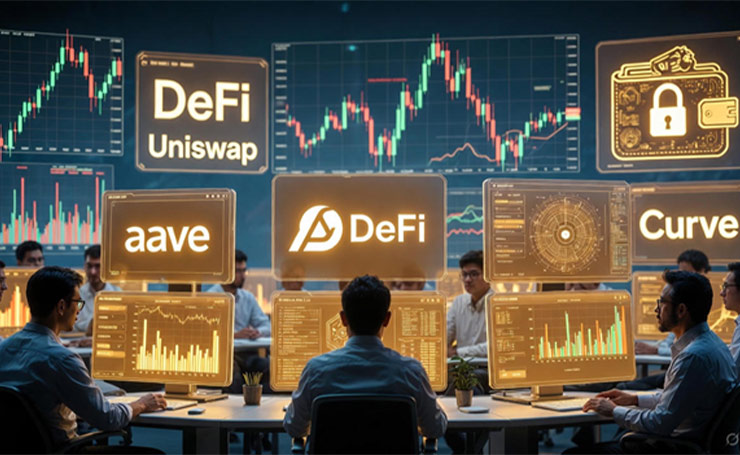
- Only rely on trusted DeFi financial services firms like Uniswap, Aave, and Curve, and avoid the new protocols offering high yields.
- Research the team, audit history, smart contracts, and community before committing funds to any decentralized platform.
- Do not invest in any DeFi opportunities without fully understanding their borrowing mechanisms.
- In order to reduce your risk of loss, spread your crypto assets to multiple DeFi platforms, but make sure to only select the trusted platforms, as told above.
- The crypto market is very volatile, hence you must understand that there can be sudden price swings, which might require you to plan your trades carefully.
- To secure your financial transactions, never share your private keys for your digital wallet with anyone.
- Keep learning about the new updates on DeFi financial services markets to keep an eye on emerging risks involved, so that you can avoid unpredictable losses.
Final Remarks
Understanding DeFi is essential for the future of banking and financial services. It enables peer-to-peer transactions and access to financial services, unlike traditional banks, allowing billions to gain access to opportunities previously restricted to centralized institutions.
- DeFi can reshape investment accounts upon expanding and being widely accepted around the globe.
- It can provide new models for providing liquidity and lending unregulated marketplace assets.
Although DeFi has come up with countless financial opportunities, it also involves risks that one can avoid by educating themselves about recent DeFi industry regulations, emerging risks, and by only relying on the established DeFi platforms.
If you are a beginner, we suggest you invest a small capital that you can afford to lose in this emerging technology, and learn it deeply before investing large amounts of your capital.
For more updates on DeFi and Cryptocurrency, keep visiting The Crypto Trends.
Frequently Asked Questions
What is DeFi (Decentralized Finance) and how does it work?
DeFi is a finance system that is built on blockchain technology and utilizes smart contracts written in code to provide financial services without using any centralized intermediaries. Users can control their assets using DeFi platforms (decentralized apps), and opt for automatic lending, borrowing, and trading related financial services, maintaining transparent and irreversible transactions over a verifiable distributed ledger.
How is DeFi different from traditional finance?
In DeFi, users can maintain the custody of their assets, eliminate intermediaries, and make fast transactions with full transparency and reduced costs using the smart contracts on public blockchains, which is totally different than traditional banking or financing systems.
What role do smart contracts play in DeFi?
Smart contracts are self-executing programs written using code that automate DeFi transactions like lending, trading, and asset transfers without intermediaries.
What are the benefits of decentralized finance?
DeFi benefits include financial inclusion, lower costs, programmability through smart contracts, full transparency, easy accessibility, global market access, and strong security via distributed ledgers and cryptographic verification.
What are the main risks of DeFi?
DeFi risks include smart contract vulnerabilities, crypto market volatility, uncertainty in regulations, fraud, liquidity shortage, systemic failures, and operational errors like lost private keys.
