

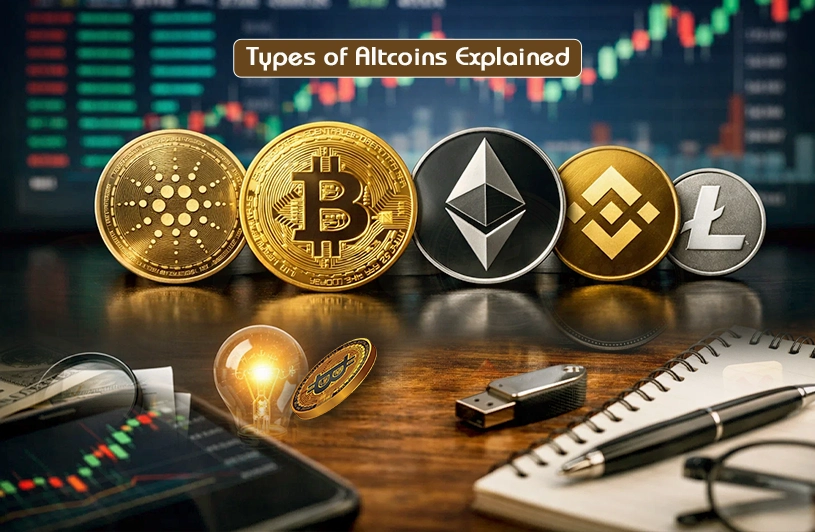
You must know that Bitcoin is the first cryptocurrency. Since its launch, it has become the foundation of a new digital economy and an inspiration for thousands of other cryptocurrencies. These “other” cryptocurrencies are called altcoins.
In this guide, we explain the types of altcoins, their uses, purposes, pros and cons, and future prospects.
30-Second Summary
- Altcoins diversify the crypto market beyond Bitcoin. Each of them has unique features and specialized solutions.
- Different altcoins serve different purposes, such as stable value (stablecoins) and gaming rewards (play-to-earn tokens).
- Understanding the risk and potential returns across different altcoins is important.
- Altcoins drive innovation in the crypto world and influence blockchain technology and financial services.
What are Altcoins and How do They Work?
Altcoins are basically all the cryptocurrencies other than Bitcoin. This term is a combination of “Alternative” and “Bitcoin”. Think of Bitcoin as the parent and all the altcoins as its children. They share some traits with Bitcoin: for instance, some are also built using Bitcoin’s open-source code, but developers change it to introduce new features. Some altcoins are built from scratch and have features beyond Bitcoin’s scope.
How Altcoins Work
Many altcoins are built using the same Bitcoin technology, so they function in a similar way. Some of them have better capabilities, like faster transactions and lower fees. However, there are some altcoins that function completely differently from Bitcoin’s core role as a peer-to-peer payment system.
Altcoins use two primary consensus mechanisms.
- Proof-of-Work (PoW): Some altcoins use this energy-intensive method, in which miners solve complicated cryptographic problems to validate transactions.
- Proof of Stake (PoS): Some altcoins use this energy-efficient method, where people stake their tokens to confirm transactions. Many cryptocurrencies, like Cardano (ADA), Polkadot (DOT), and Solana (SOL), use this system.
Types of Altcoins
Altcoins are generally classified based on their specific purposes. Here are common categories.

Meme Coins
Meme coins are inspired by viral jokes. In April and May of 2021, these coins became dramatically popular and shot up in value solely on speculation.
The examples of meme coins include Dogecoin (DOGE), Shiba Inu (SHIB), and Pepe (PEPE).
Stablecoins
Stablecoins are designed to keep a steady value as they are pegged to real-life assets, such as regular money or precious metals. It prevents any sharp price swings. These coins are used for savings and transactions.
The common stablecoins are Tether (USDT) and USD Coin (USDC)
Privacy Coins
Privacy coins focus on protecting user identity and transaction details. They hide transaction amounts, wallet addresses, and offer enhanced anonymity. They appeal to users who like financial privacy over transparency.
The examples include Monero (XMR), Dash (DASH), and Zcash (ZEC).
Utility Tokens
These tokens are used to pay for services, fees, or rewards inside a network. People use it to buy storage space and keep data safe on the network.
The common utility tokens are Basic Attention Token (BAT), Chainlink (LINK), and Filecoin (FIL).
Security Tokens
Security tokens can be transformed into digital tokens and traded on stock markets, a process called tokenization. People use it for real estate or stocks. Therefore, to keep these assets protected, security tokens follow strict rules of the Securities and Exchange Commission.
Some examples of security tokens are INX and Blockchain Capital (BCAP).
Play-to-Earn Tokens
These tokens are available in gaming, where people earn them by simply playing games. Players can use these tokens in different ways, such as buying in-game items and game-inspired NFTs. They can also exchange these tokens for other cryptocurrencies or change them into fiat currencies.
Top examples include AXS (Axie Infinity), MANA (Decentraland), and SAND (The Sandbox).
Governance Tokens
Governance tokens empower investors and give them the authority to shape the future of the projects they invest in. They can vote for changes in rules and decisions in a DAO (Decentralized Autonomous Organization).
Some examples of these tokens include Maker (MKR), Aave (AAVE), and Compound (COMP).
The Purpose of Altcoins
Understanding the purpose of altcoins is important to see why the crypto market has extended beyond Bitcoin.

Innovation and Diversity
Altcoins are major drivers behind innovation and diversity in blockchain as they enable DeFi (decentralized finance), privacy-focused transactions, and expandable infrastructure. Coins like Ethereum show how altcoins scale blockchain functionality.
Unique Features
Altcoins offer features that are beyond Bitcoin’s scope, such as lower fees, quick transactions, and specialized solutions. These features allow altcoins to solve specific industry issues.
Crypto Ecosystem Influence
Altcoins continue to drive technological innovation and competition. Many features that were introduced by altcoins were adopted by major networks such as Bitcoin.
Pros and Cons of Altcoins
| Pros | Cons |
| Diversification: Provides alternatives to Bitcoin, reducing risk. | High Volatility: Prices can fluctuate dramatically. |
| Innovation: Many altcoins offer unique features (smart contracts, privacy, etc.). | Lower Liquidity: Harder to buy/sell compared to Bitcoin. |
| Lower Entry Costs: Some altcoins are cheaper per coin, making them accessible. | Regulatory Uncertainty: Some altcoins face legal restrictions. |
| Faster Transactions: Some altcoins have faster transaction times. | Security Risks: Smaller projects may be vulnerable to hacks. |
| Potential High Returns: Early investment can yield significant profits. | Less Adoption: Fewer merchants and platforms accept them. |
Future Trends and Predictions for Altcoins
The future of the altcoins is similar to the money system in 19th-century America, where many local currencies were used, each with its own features. Local banks were also issuing their own money, sometimes without real reserves to support it.
Today, the altcoin market works in a similar way. There are thousands of altcoins with their distinct features and purposes. Most of them might not survive long-term. The ones becoming dominant will have strong utility, real-world use cases, and solid technology.

Altcoins also offer diversification at a lower cost than Bitcoin. However, the cryptocurrency market is highly volatile. Cryptocurrency is still evolving and trying to find its role in the global economy. So, it is important to approach all decentralized money with caution.
How to Choose the Right Altcoin Category
Before choosing an altcoin category, consider the following to make the right decision.
- Your risk tolerance
- Whether you want utility or speculation
- Long-term potential or short-term trends
As a wise investor, understanding categories is more important than chasing the latest coin.
Conclusion
The cryptocurrency market offers way more than just Bitcoin. From utility coins to privacy tokens, each altcoin category has a specific purpose that you should understand before investing.
This guide explored major types of altcoins to help you make informed decisions and showcase the evolving nature of the crypto world.
For more interesting blogs, feel free to visit The Crypto Trends.
FAQs
How do Stablecoins like USDT maintain a Stable Value?
Stablecoins have a steady value because they are tied to real-world assets like traditional currency (USD or Euro) and precious metals (gold and silver). For example, 1 USDT is equal to 1 US dollar.
How do Utility Tokens and Security Tokens Differ in Cryptocurrency?
Utility tokens are used to get access to a product or a service within a blockchain network, like BAT is used for digital advertising. On the contrary, security tokens represent real-world assets (real estate or stocks) and follow strict regulations.
Can I Use Meme Coins for Real Transactions?
Yes, meme coins can be used for transactions, but their primary use is speculative trading and community engagement. For instance, some payment platforms may accept Dogecoin, but its high volatility makes it less reliable than stablecoins and other major cryptocurrencies, like Bitcoin.
How do Governance Tokens Impact Decisions in Decentralized Projects?
Governance tokens give investors voting powers over upgrades and project decisions in decentralized autonomous organizations (DAOs). This gives voters a say in the project’s future, unlike regular tokens, which only serve as currency or utility.
